
Califauna: Art & Conservation in Education

The following is a guest post by my pal Chris McCormick, founder of Califauna and a passionate artist. The project is currently targeted to launch in late 2008. I hope you will support it.

There are many ways that we learn. A method used increasingly by forward thinking schools is “arts integration.” The belief is that by integrating the arts into other studies there is a better understanding of the lessons taught. To this end I have started a nonprofit called “Califauna.”

The goal of Califauna is to bring art education and eco-awareness to the students of California. By integrating art lessons with information about our wildlife I believe we can have an impact in helping people understand the need to care for our forests, deserts and beaches and all the animals that live there.

By picking an animal then discussing its habits and habitats we can educate on that animal and our effects on them, then by transitioning the lessons to some form of artwork based on that animal we can better help the student understand the need to care for and help our wildlife to survive.

Can art be integrated into animal careers? Of course it can, you can partner with local artists and develop programs of your own.

I believe we each have a responsibility to do our part, to share information to help people make better choices. Whether done through animal careers or art careers or a combination of both, if children are informed on the need to care for our native animals and what they can do to help, they will then share that information with their friends and family. Kids are always eager to share what they learn!

About the Contributor: Chris McCormick is an artist and animal lover. He runs a variety of blogs including Southern California Potters, and Califauna. He was recently interviewed as a featured artist in the Fawnskin Flyer.

About Califauna: Califauna is a nonprofit project and operates under the guidance of the Pasadena Arts Council, a 501(c)(3) Organization. Califauna seeks to integrate arts education with Eco Awareness for the youth of today in hopes that they will take with them a better understanding of the need to care for our environment, from their own backyards, to our local beaches, mountains and deserts.

Cats & Kittens: Developmental Stages

Cats are becoming the pet of choice here in the United States. Unfortunately many people still subscribe to the dark ages of thinking when it comes to those fabulous felines.

In a recent pet magazine I read all about young animals but when it came to kittens–they were given only a measly mention instead of a full section on the topic.

Socializing cats should no longer be an option–it is a crucial piece to creating a calm and well adjusted feline.

Many people today send kittens or puppies away from the birth home too quickly. In fact, some behavior problems (such as inappropriate suckling) are thought to be a direct result of early removal of kittens.

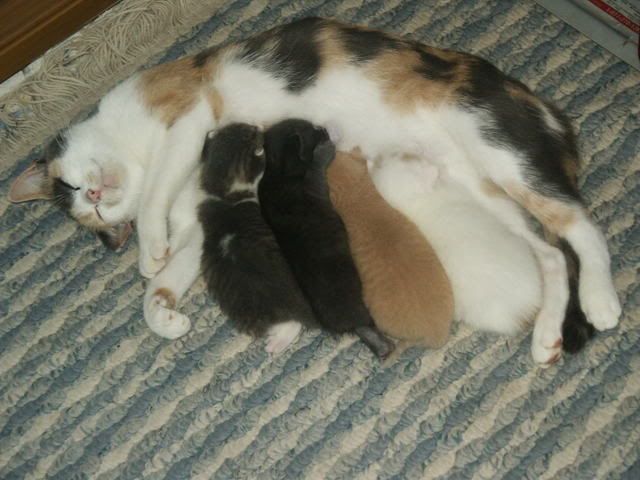
Although kittens will wean around six to seven weeks of age, many will continue to comfort suckle. The queen (female cat) gradually leaves the litter for longer periods of time.

Ideally, kittens will remain with the queen and litter for at least 12 weeks–and in some breeds 14 would be better.

As kittens grow it is important to have human contact. Talking, handling, and playtime helps them to acclimate to humans. If you can invite kids, friends, and other family members to help you in this process your kittens will develop a good well rounded foundation that will serve them well later.

When young kittens are orphaned or separated from the queen and litter mates they usually fail to develop good social skills with others of their kind.

This is because during day-to-day interactions they learn body language signals, clawing and biting inhibition. Play and interactions also help them to develop physical coordination and understanding of fluctuations in social status.

Brain development is though to be enhanced by handling and environmental enrichment if provided for regularly for the first seven weeks of life. Most of my clients are encouraged to give quality time to their pets at least 30 minutes twice a day–if not more.

Many of my breeder pals often hand me their animal babies (birds, cats, and dogs) even asking me to pet them when their eyes are closed (some believe that they should not be handled until after two weeks of age) because they think that it makes them more resilient, able to handle change more readily, and habituates them to strangers–and any changes (stress) in the environment.

Today, you can enroll in kitten kindergarten classes to learn how to help your kitten become a good citizen and social beast.

Classes are still not as common as puppy preschool but my belief is that these courses, along with pet parenting schools, are going to make long term differences in the life and behavior of the animal.

The big PLUS is that these lessons will help keep them in the home…because early education prevents the problems that land cats and kittens in shelters or abandoned to a cruel fate.

General guidelines on kitten development:

Neonate Period (0-2 Weeks)

*Stay close to mom and litter mates.

*Orient toward noise.

*Root (squirmy movement) to feed.

*Low level competition for territory (nipple) and rank.

*Learning skills and socialization to others is thought to come from separation from mother and litter mates during this phase. Critical for developmental learning to be in a stable group.

Social Period (2 to 7 Weeks)

*Week Two: Eyes are usually open.

*Week Three: Both smell and sight is developed enough for them to find their mother.

*Week Four: Smelling skills mature and hearing is good. Interactions with siblings increases. Teeth begin to erupt and they can walk fairly well.

*Week Five: Sight is mature and kittens can run, right themselves when turned over, avoid obstacles, begin to stalk and pounce, and step precisely.

*Begin to groom themselves and participate in social grooming with others.

*Week 6 & 7: Refine motor abilities, social interaction, and develop more regular sleeping patterns

Active Social Period (7-14 Weeks)

*Observational Learning: During this period kittens are refining their social skills and physical coordination. Learning in this period comes from observation (and interactions) with the mother, litter mates, humans, and other cats.

*Object Play: Grabbing objects and toys, pawing, tossing, and holding or carrying.

*Social Play: Pouncing, leaping, tail chasing, grabbing with paws, ambushing, licking.

Hierarchical Period (3-6 Months)

*Adolescents begin to establish their place within the household (cats, humans, other animals) in subtle or overt activities.

*Testing the limits of rules or established patterns may contribute to squabbles.

*Neutering or spaying is advised prior to the exhibiting of sexual patterns.

Adolescence to Maturity Period (6-24 months)

*Sexual behavior ( if not spayed or neutered) exhibited.

*Escalated exploration and challenges for rank (which includes testing limits and rules with humans).