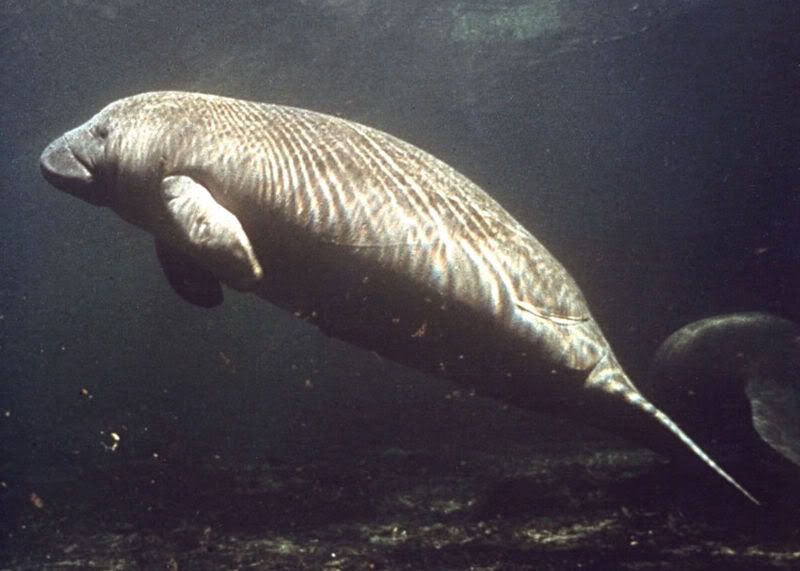
So, manatees are in the news again. Sharpie, a rescued and rehabilitated manatee was recently released back into the waters of Florida. He has been called the “poster child” for manatees and you might want to watch the his manatee release video.
I’m not sure why I am on the marine tangent but perhaps it has to do with Earth Day and reflections over where I am going next with my career.
In the meantime, I just finished an article about mountain vacationing pet safety…which talks a bit about the problems facing pets and wildlife.
It makes me sick that fishing filament, hooks, bait, and lures continue to injure and kill marine life and waterfowl. This same litter that people leave behind also injures pets on a regular basis.
Is it so hard to pick up before leaving an area? What I don’t get is that if people enjoy the wilderness and fishing and boating so much–why on earth would they litter and leave potentially lethal debris behind?
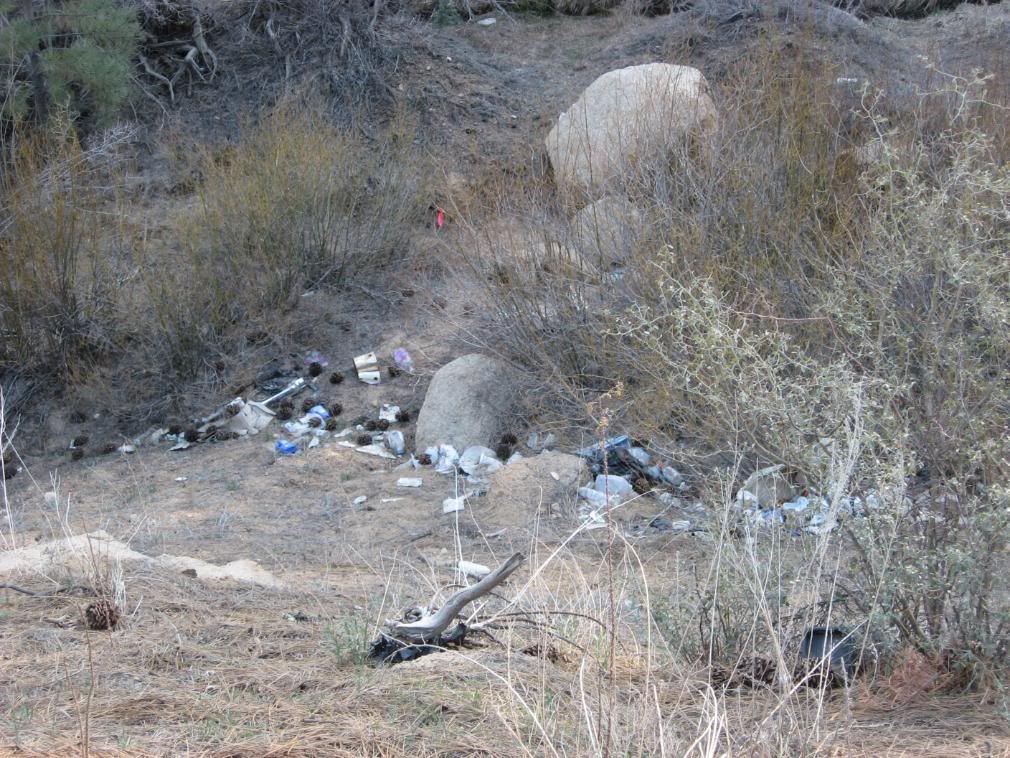
Above: Trash thrown over the side about Grout Creek–a local creek that runs down into the lake and a tributary that trout come up to spawn.
Last year I took an early morning amble and met up with a neighbor whose dog grabbed some bait–complete with hooks. I sent her for help while I restrained the dog and prevented the animal from making her own situation worse.
I gave the owner specific instructions to help keep her from panicking…which she was on the verge of doing.
The good news is that the hook got caught in the flesh of the dog’s upper palate instead of being swallowed–and the filament was still attached. When the filament is still attached–it helps the veterinarian locate and access the hook quicker.
While I restrained the pet, the owner caught a lift home and then drove back to get us. Never mind my car sickness from riding in the back of a car speeding down the winding highway on the way…
Urp.
Fortunately, I kept my cookies while also keeping the dog successfully restrained.
We quickly got the animal to the veterinarian–who was alerted to our situation by phone and so staff were awaiting our arrival. Lucky for us and the dog who was immediately taken into surgery.
So much for my walk that day and I made sure to drop by their home after the procedure was done. It was amusing–since the dog proceeded to tell me all about the adventure. She talked and talked and wiggled and waggled close to me.
Both the owner and I chuckled over it. I told the dog that she didn’t need to be a “drama dog” and that she should bail of the whole bait obsession.
Unfortunately, animals act like animals and so they will grab bait or become the unknowing victims of monofilament, plastics, and other such garbage people leave behind–no matter what you tell them–or how closely you try to monitor them.
Wildlife have problems with such litter frequently…
…approximately 30% of manatee deaths have been directly attributable to human-related causes, including watercraft collisions, accidental crushing and drowning in water control structures, and entanglements in fishing gear…[Read More]
Now the actual population status of the manatee population off the coast of Florida is not known–only estimated. In January 2000 the estimate was numbered at 2,222 manatees statewide–up from 737 or so in the mid-1970s.
Unfortunately, the counts could vary widely depending on weather conditions. The raw numbers alone do not provide an accurate picture of population trends and many do not believe the state of Florida is doing a very good sampling of the manatee population and the proposed changes to the procedures do not sound like they are too popular either.
The manatee population aerial surveys are conducted in a particular time frame but that is not all they do. The U.S. Geological Survey’s Sirenia Project, in cooperation with the Florida Fish and Wildlife Conservation Commission, maintains a computerized database of identified manatees.
This database is called the Manatee Individual Photo-Identification System (MIPS) and contains nearly 2,000 records of individual manatees with unique features. Tagging and other efforts are part of the monitoring process.
Funding cuts and other issues remain other problems facing these creatures.
Want to help manatees? Visit:



Bear Attack: How will you die?
Locally there was a bear attack today…and it involved an animal actor from Predators in Action. It was not a native wild bear.
Incidentally, the Grizzly is five years of age and in his prime. Adolescent animals can be a handful–just like teens they test the limits and really begin to feel their oats.
Early in my career one of my relatives said she expected to one day hear that I might be killed by one of the animals I worked with.
I thought it was a morbid thought–and strange that she would ponder my death as I was still pretty young.
When you are young you don’t think about death too much. Lately, I’ve lost a string of family and friends–it really is tough on a body…and it makes you look at your own mortality.
The reality is that one of the occupational hazards of working with wildlife is that they are big and strong and can kill you intentionally–or by accident.
Early in my career I witnessed many incidents and I’ve been diligent because of it.
When my friends hugged a tiger or lion in the photos, I merely kneeled with a tiger for mine.
My pals questioned me about my caution…and chided me for it. Most of them are no longer in the industry.
Silly? No, I don’t think so. Remember the high school girl who was mauled by a tiger during a photo shoot?
There are incidents every year involving animals. I lost a college buddy to a tiger attack just shortly after we graduated from our animal training school. A few years later another professional acquaintance was decapitated on the cables of an elephant yard…
Sadly, I’ve been front and center when a lion attacked another trainer a short distance away from where I was tossing students into empty cages–as I anticipated trouble.
I gotta say I admired his back-up trainer who stood over him with a hickory cane prepared to defend him from further attacks by the lion–who was too busy fighting another male through the fence.
Personally, I think it is a number’s game. When you work long enough, and close enough, with animals you will have an incident of one type or another.
One of my few was when dolphin tried to submerge me–the other trainers (in another country) did not heed my request to be pulled from the tank prior to the incident.
Yes, I escaped unharmed but there is nothing like an animal incident to shake your foundation and remind you to remain diligent. And to really find those people who can be good back-up trainers because your life depends on it.
The bear attack locally was fatal.
Just last night we were just discussing the facility and the bear while watching a commercial for a building supply store.
My guest wondered if it the star was a local animal actor. I didn’t see the front teeth of the bear and was explaining that it used to be common practice to pull the canines of animal acting bears early in my career. Our local animal acting bear has his teeth.
The conversation morphed into a bigger issue related to people misunderstanding animals and the difference between working with a wild animal and a domestic creature.
People want to believe that wild creatures are benevolent and tame. They aren’t.
When you raise and work with the animals they accept you into their realm of familiars and so treat you as such. This can work in your favor or against you.
Many of my family and friends used to “tsk, tsk” during our conversations early in my career because they could never discern between my discussions about my human pals or my animal ones.
Personally, I didn’t know to many people by the name of Sheeva, Tambui, or Zamba–but hey, it might just be me.
Besides, I spent more time with the animals than I did the people–and yes, I considered them my buddies but not once did I ever doubt their wild natures or the fact that under the right circumstances I might be injured.
When I was wrestling a bear, prepping for a movie, the animal got a bit “hot.” He was about five and in his prime. As I wrestled I told my back-up trainers he was hurting me but I sounded too calm–and they didn’t pay attention.
I let the animal take me down and it took four or five guys to pull him off.
It was a minor incident. My instincts told me to relax and go down to the ground. Had I not, he might of done some damage. The jaws, even without the front teeth, are powerful.
There are a lot of other deaths more common than one from an animal attack. However, I think animal attacks touch a primal fear response and so attract a morbid fascination because of it.
You are more likely to die in an incident involving a car or perhaps a sport related accident than from an animal attack–but when you are an animal trainer–it remains a risk your entire career.
Anyway, my rambling here is to say that we all are sadden by the incident at Predators in Action no matter who it involved.
As for the bear, the determination about what happens to him will be made by the regulatory agencies. He was, after all, just being a bear.
Our community sends our best wishes for the family and friends of the victim and our hopes are that any decisions related to the animal compound, staff, and animals be fair and just.