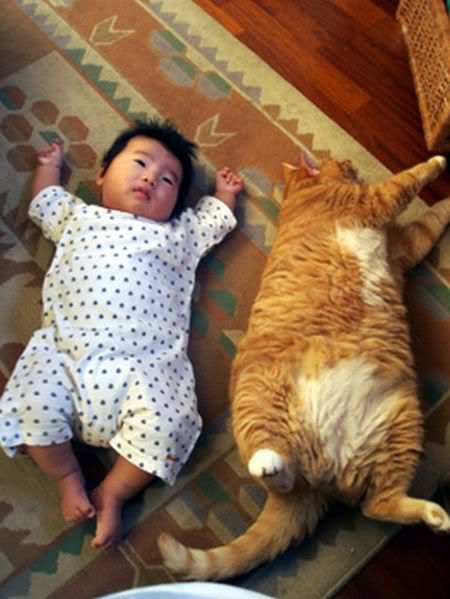
Above: Photo of baby and cat courtesy of the NobodyCallsMeThatBlog.
I recently got a call from HM (handsome man aka my significant other) because his pal’s wife had tossed the cats outside since they have a newborn. She was worried that the cats would hurt their newborn and he was wondering if that was a realistic threat.
Unfortunately this is not an isolated case of such behavior. Pregnancy forums spread rumors of cats suffocating babies and the risk of toxoplasmosis from cat litter boxes on a regular basis.
The problem is that people spread the rumors quickly without checking the facts.
Let me just be perfectly clear about the safety factor when it comes to kids and pets:
Infants and animals should never be left together unsupervised. This means that if you are not in the room or watching the infant–you should make sure the animals do not have access to that infant.
Over the years members of the feline race have been blamed for cases of crib death or Sudden Infant Death Syndrome (SIDS). However, I don’t know of any substantiation to back it up.
I found one reference to The Annual Register in January, 1791 cited at the Messy Beast where an eighteen month old was reported by the coroner “to have died “in consequence of a cat sucking its breath.”
Hmm, 1791 Plymouth–not the most sophisticated of times–and sucking its breath?
Puh-lease.
A more recent warning appeared in You and Your Cat by David Taylor (published in 1986).
The reality of the situation is that suffocation is a serious danger because infants are not coordinated nor strong enough to push an animal away if it climbs onto its face or chest.
To prevent such problems animals and kids should always be supervised. Simple steps? Close doors, temporarily install screen doors indoors, or use Baby Safety Netting or Baby Infant Stroller Crib Nets to keep critters out of the infant’s sleeping areas and their strollers.


Can I get Toxoplasma gondii from my cat?
Above: Cat & Baby photo copyright by Andy Gunn.
Many pregnant women are concerned about contracting toxoplasmosis from their cat or the cat’s litter box.
Since I am tackling topics related to cats and babies, I thought it might be a good time to discuss the life cycle of Toxoplasma gondii (T. gondii) and the role that cats play in disease transmission.
My goal? To soothe some of the fear surrounding the contracting of congenital toxoplasmosis from your feline.
How great is the risk of contracting toxoplasmosis from a cat?
Risk from eating raw or undercooked meat, drinking unpasturized milk, and exposure through gardening or children’s sandboxes are some of the many ways people contract toxoplasmosis. Holly Nash, DVM wrote a good summary of the toxoplasma gondii and stated,
Toxplasma gondii is a protozoan organism that can be found in several different types of intermediate hosts.
Once a cat has been infected, the animal builds up an immunity and is rarely reinfected. During the first exposure to T. gondii a cat will excrete infectious oocysts (reproducing microorganisms) which require a one to five day incubation before they become infectious.
Only cats who eat the cysts can get infected. So, outdoor cats who hunt and eat rodents and birds or those fed raw food diets are the ones who may be exposed. For two weeks after the first exposure to the disease a cat excretes oocysts (after they are usually immune).
Tips for avoiding toxoplasmosis:
Don’t get rid of your cat–it is not a necessary precaution to take when you are pregnant.
Although it is possible to get toxoplasmosis from an infected feline, the risk is extremely low, especially if you follow the recommendations above.
To combat the misinformation, the Humane Society of the United States contacted more than 31,000 obstetricians and gynecologists nationwide and provided them with a packet of information to help their patients understand the facts about the risks of toxoplasmosis.
Download Your Pregnancy Your Cat (PDF) or request Your Baby & Your Pet, or the clinician guide Toxoplasmosis: A Practical Guide for the Clinician, by sending a Self Addressed Stamped Envelope to: BabyPet eNews, 2100 L Street NW, Washington, DC 21007.
Read more on Toxoplasma gondii at the Center for Disease Control (CDC) and read the toxoplasma gondii fact sheet.