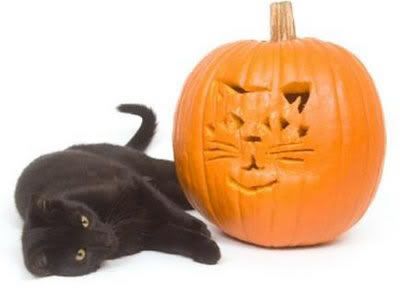
Earlier in this series I wrote about pet Halloween hazards but I thought it might be worth discussing another controversial Halloween danger that black cats face.
Some people dismiss this topic as urban legend but Snopes, the Internet site that works to confirm or deny the rumors circulating out in cyberspace, writes that their investigation into the topic of routine sacrifices of black cats on Halloween was inconclusive.
When looking for actual documentation surrounding the issue, I can’t find much.
Back in 1999 the Washington Post covered why many animal shelters suspend the adoption of black cats near Halloween but in 2007 National Geographic quoted experts saying that ritual cat sacrifices was an urban myth and included this morbid cat picture of a black cat. (Found on November 1st).
Even the Religious Tolerance website files the ritual abuse and sacrifice of cats under Halloween hoaxes.
So, is it ritualistic sacrifice or morbid, sick individuals mutilating animals?
My thought is that if it is happening to animals, and it escalates around Halloween, then why not keep those animals inside and delay placing them up for adoption for a couple of days?
People have odd ideas surrounding black cats and usually have a story to share.
I remember a cat that lived in the animal shelter where I was working as an adoption counselor. His name was listed as “Satin” but I somehow always called him “Satan”instead.
When I complained about this to the kennel manager, she laughed. Turns out that his real name was “Satan” but they had changed it to overcome the stigma of the name and to get him adopted.
Go figure.
That stigma surround black cats remains which is just a darn shame. Just where does it come from?
Cats have often been associated with witchcraft as Your Magickal Cat details.
In Greek mythology the Hecate (known to some as the mother of witchcraft) turned a woman into black cat and she served as a priestess at the triple goddess Hecate‘s temple. (Read more about Hecate online or books about the goddess Hecate.)

Much of the association between cats and witches seems to have gained hold during the 12th and 13th centuries when European witches were often associated with black cat “familiars.”
Witches were also suspected of morphing into feline form and this belief persisted into the 17th century when witches and their cats were burned alongside each other.
Today superstitious people in the United States and some European countries believe that black cats signify bad luck.
I find it funny that in England this is opposite–you experience good luck if a black cat crosses your path.
Personally, I think cats fare better if kept indoors for a variety of reasons–and keeping them in during this time of year is prudent.
What do you think–leave your comment below?
 Star Wars Yoda Pet Dog Halloween Costume
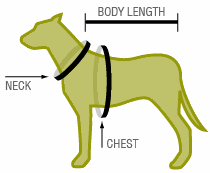 Neck: Measure the neck length as you would for a collar but remember that a costume should be much looser around the neck.
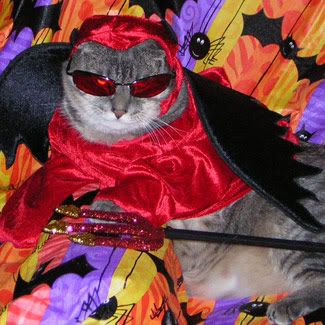 Now the best technique is to purchase the Halloween pet costume early so that training can be done in short increments over a couple of weeks–but if you are like most people you probably have waited until the last minute!